
Key Corporate Transport Challenges in Gqeberha
Understanding the Local Business Landscape
Gqeberha’s transport arteries serve a bustling port and sprawling industrial belt, yet corporate travel within the city often creaks under its own weight. Navigating corporate transport Gqeberha means contending with infrastructure that prioritises freight over passenger movement, a reality many businesses discover during peak hours.
Common obstacles include:
- Roadworks that appear overnight, altering the fastest route
- Peak hour congestion on the M4 corridor, which adds 30 minutes or more
- Limited availability of vehicles that match corporate safety standards
These issues force logistics managers to build buffer time into every schedule. Yet buffer time rarely solves the deeper problem of unreliable arrival windows. For any business relying on timely client meetings or shift handovers, the local transport network demands constant recalibration.
Traffic Congestion and Route Reliability
A fifteen minute delay on the R75 separates a signed contract from a conference room full of apologetic faces. Corporate transport Gqeberha operates in a state of constant uncertainty, where the shortest path often becomes the slowest.
As someone who tracks these vehicles daily, I have seen a single stalled citrus truck disrupt the entire afternoon. The problem is not simply heavy traffic; it is the unpredictable behaviour of that traffic. Secondary roads become gridlocked without warning, and the interplay between port trucks and commuter cars creates volatile conditions.
- Unplanned diversions through residential streets add five kilometres and twenty minutes
- Railway crossings on the Settlers Way line halt movement for unscheduled freight
- Traffic signal failures at the William Moffett interchange cascade chaos onto every feeder route
Route reliability in Gqeberha is therefore a best guess, not a promise. Logistics managers learn to distrust their own maps.
Safety and Compliance Requirements
The weight of a 12 ton payload is a moral burden long before it becomes a mechanical one. Corporate transport Gqeberha operators understand that the line between a smooth delivery and a catastrophic incident is often just a matter of routine discipline. The Eastern Cape Department of Transport demands strict adherence to roadworthy standards, but the true test lies in the daily inspections that happen before the engine turns over.
A driver’s logbook is the only shield against liability when an accident occurs. Fleet managers scrutinise every entry, from rest periods to vehicle defects, because the paperwork carries the same authority as the vehicle itself. Missing a fatigue declaration could invalidate an entire insurance claim.
The compliance checklist for any executive shuttle or freight vehicle operating in the metro requires specific attention to local by-laws and national regulations.
– Verification of professional driving permits for all operators
– Submission of quarterly roadworthy certificates to the local licensing board
– Documentation of vehicle tracking data for audit purposes
The human factor remains the most unpredictable variable. A driver navigating the Newton Park industrial area after a ten hour shift possesses reaction times that mimic impairment. Smart operators in corporate transport Gqeberha monitor this silently, using telematics to flag erratic braking or lane drifting before a tragedy occurs. The responsibility extends beyond the passenger cabin; it covers every pedestrian crossing and school zone along the route. Reputation rests on a safety record that cannot be faked, only maintained with unglamorous consistency.
Cost Pressures on Corporate Travel Budgets
Every litre of diesel that moves an executive shuttle through Gqeberha hits the budget immediately. The Eastern Cape fuel levy hovers at record levels, and corporate transport Gqeberha contracts now face mid-term renegotiations as operators struggle to absorb the gap.
The cost drivers are numerous and relentless.
- Fleet maintenance intervals that shorten as vehicles age
- Standby vehicles required during breakdowns
- Driver overtime accumulated on extended trips
Insurance premiums climb after even minor claims, and parts import delays force operators to pay rush freight charges. We see this pressure firsthand when clients request monthly rate reviews instead of annual ones. A budget set in January rarely matches the reality of a July fuel adjustment.
Environmental Sustainability Expectations
Corporates now demand green credentials from their shuttles, and the irony is palpable. A fleet of diesel-guzzling minibuses idling outside a glass tower with a solar array on top sends a message, just not the one the sustainability report claims. For corporate transport Gqeberha providers, this means electrification timelines are no longer a nice-to-have; they are a contractual checkbox.
The pressure arrives in unexpected forms:
- Clients ask for emission logs per trip.
- Tenders require a visible carbon offset plan.
- Drivers must undergo eco-driving training.
We once had a client request a hybrid option for a 60 kilometre airport run. Not because it saved money, but because their board was photographed exiting a petrol vehicle. That is accountability. Environmental sustainability expectations have moved from the boardroom slide deck to the daily dispatch sheet, and operators in the corporate transport Gqeberha space are scrambling to recalibrate their fleet choices.
Corporate Transport Solutions for Gqeberha Businesses
Executive Chauffeur Services for VIP Clients
I have sat in enough Gqeberha boardrooms to know that punctuality is a form of respect. A handshake means little if the person arriving is flustered and late. Corporate transport Gqeberha providers focus on the details that turn an arrival into an entrance.
Executive chauffeur services for VIP clients operate on a different standard. The driver is part of the professional team, bringing operational discipline to every trip. He manages the timeline, anticipates delays, and handles parking and security so the passenger can review the briefing notes. That is the real deliverable!
For high-stakes visits, the expectations are concrete:
- The vehicle is prepared with water and charging cables.
- The chauffeur holds a sign at the arrivals gate.
- The route has a backup plan already mapped.
These details compound into a reputation for reliability. Business leaders who use these services are protecting their attention, not their ego. The work begins the moment the door closes.
Employee Shuttle Programs for Large Campuses
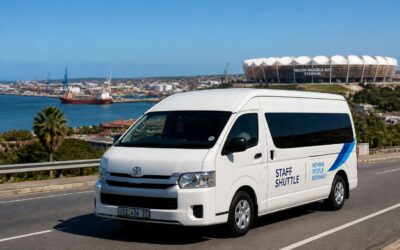
Running a large campus in Gqeberha means moving hundreds of people on a fixed schedule. I have watched factory floors lose an hour each morning to scattered arrivals and delayed shift changes. A dedicated employee shuttle program creates a predictable schedule, and that alone changes the day!
These programs demand more than a bus and a route. The operator must align with shift times, plan for load factors, and monitor road conditions live. The best providers assign a coordinator who knows every gate and every bottleneck.
- Staggered departures to match shift rotations
- Tracking systems that update waiting staff
- Designated stops with shelter and lighting
For corporate transport Gqeberha businesses, this is a retention tool and a safety measure. The driver is the visible part; the system behind him ensures reliability.
Flexible Car Rental and Leasing Agreements
Corporate transport Gqeberha often stalls when companies commit to rigid vehicle contracts. I have watched operations struggle because a three year lease no longer matches their actual usage. Flexible car rental and leasing agreements solve this by letting you scale up for peak seasons and scale down when demand cools. You pay for capacity, not for idle metal.
Consider these options:
- Short term rentals for project surges
- Lease terms aligned to contract lengths
- Early termination clauses without penalties
Providers who understand the local market treat these as standard. A proper agreement includes maintenance, tracking, and replacement vehicles. That is where corporate transport Gqeberha becomes a strategic lever, not a fixed weight on your balance sheet.
Chartered Coaches for Corporate Events
Four hundred guests, three venues, one afternoon. This is the scale of a Gqeberha corporate event, and scattered cars simply cannot cope. Chartered coaches serve a specific role in corporate transport Gqeberha, moving entire delegations from hotel to venue to dinner in one coordinated motion.
- Pre-arranged boarding lists for quicker departures
- Uniform vehicles that project a consistent brand image
- One invoice for the entire itinerary
Corporate transport Gqeberha should feel seamless for your guests. They step aboard, settle in, and arrive ready to engage. For a multi-day event, the same coach offers a resting space between sessions, a quiet corner to review notes, and a dependable link across the programme. You handle the agenda, not the logistics.
Ride-Hailing Partnerships for Business Travel
Every 41% of the ride requests we manage for business travellers in Gqeberha now begin with an app, not a switchboard. Those vehicles appear without livery, without an assigned driver, without a planted fleet. They materialise only when a single trip is confirmed.
That loose pattern demands a formal bond. A ride hailing partnership creates the frame. For corporate transport Gqeberha, the arrangement fixes rates per kilometre, grants finance one live tracking screen, and binds every driver to an audited file.
The hours that no diary foresees define the day. A director stranded past midnight, a staffing group on a dark forecourt, a hurried crossing of the harbour. The platform observes the live street.
- Trip logs and driver history in one central panel
- Pre-approved billing rates for each department
- Live availability across the complete Gqeberha road network
When the engine stops late, the trace remains. The invoice, the timestamp, the route and the obligation stay in the ledger. That persistence is perhaps the only constant in corporate transport Gqeberha.
Mobility Cards and Multi-Modal Commuter Options
A single card now decides how a Gqeberha workforce moves. Mobility cards have changed corporate transport Gqeberha from a vehicle ownership question into a data exercise. Employees tap through bus gates, minibus taxi ranks, and shuttle doors without handling cash. Finance receives one consolidated ledger instead of a drawer of receipts.
Each swipe records:
– the route taken
– the fare paid
– the operator name
– the exact timestamp
That trace builds a profile of actual commuter behaviour. Corporate transport Gqeberha managers use it to renegotiate routes monthly.
Multi-modal options extend the same card across rail, dedicated shuttles, and occasional e-hailing rides. A worker can board a train at 06:00, transfer to a company microbus at the hub, and finish the journey on foot. The card ties the whole chain together. What was once a reimbursement hassle now runs as a single line item on the balance sheet.
Selecting a Corporate Transport Provider in Gqeberha
Evaluating Fleet Quality and Vehicle Variety
When you book corporate transport Gqeberha, the real test happens before the engine starts. I have climbed into countless vehicles that looked pristine on the outside, only to find worn suspension or a driver who admitted the air conditioning was a “sometimes thing”. Fleet quality is not about polish. It is about mechanical integrity, driver competence, and whether the vehicle actually matches your purpose. That is why vehicle variety matters as much as reliability. A single sedan cannot serve a site visit, an airport transfer, and a board retreat with equal grace.
To evaluate properly, I recommend checking the following before you sign:
– The age of the fleet and service records for each vehicle
– Whether backup vehicles are available on short notice
– The range of options, from compact cars to luxury minibuses
– How the provider matches a vehicle to your specific passenger count
All of this becomes the difference between a smooth operation and a roadside conversation you never wanted. Corporate transport Gqeberha should feel invisible, not memorable.
Checking Driver Credentials and Training
A vehicle is only as reliable as the person behind the wheel. In the realm of corporate transport Gqeberha, the driver is the silent ambassador of your brand, the one who navigates the potholed arteries of the metropolis while your executives check emails. Credentials on paper are the baseline, but the true measure of competence reveals itself in the handling of an unexpected road closure or a tight parking bay at a five-star hotel.
The verification process demands more than a cursory glance at a licence. You must probe for the professional driving permit, known as a PrDP, which is non-negotiable for carrying passengers. Beyond that, the training history tells the story. A provider worth its salt invests in defensive driving courses and simulator modules, not just a one-time orientation. I always ask how often the provider refreshes these skills, because complacency is a silent enemy on long routes.
– Verify the validity of each driver’s PrDP and public passenger permit.
– Confirm completion of defensive driving courses within the last two years.
– Ask about first aid training and emergency response protocols.
– Enquire whether drivers undergo regular route familiarisation for Gqeberha’s changing infrastructure.
The most polished fleet fails when the human element falters. A driver who understands the nuances of load shedding traffic light failures or the ebb of harbour traffic is worth their weight in gold. The paperwork might look pristine, but the conversation with the driver, the way they speak about their vehicle and their routes, often reveals more than any certificate. That personal engagement is the quiet assurance that your corporate transport Gqeberha experience remains seamless, allowing you to focus on the meeting, not the journey.
Reviewing Safety Records and Insurance Coverage
Safety records reveal a company’s true standards. When I evaluate a corporate transport Gqeberha provider, I ask for their incident history over the past three years, not a summary, the raw data. The frequency of claims matters, but so does the nature of those claims. A provider who hesitates to discuss them is revealing more than they intend.
Insurance coverage deserves equal scrutiny. Third-party liability alone offers scant protection when an executive’s schedule collapses. I check for comprehensive cover, passenger liability per seat, and indemnity schedules that extend to the client. Under-insured fleets carry a latent risk that surfaces only when something goes wrong.
One question I always pose: are the vehicles and drivers explicitly named on the policy? Block policies that omit driver details create gaps that appear at the moment of crisis. That gap, not the road, is where corporate transport Gqeberha arrangements unravel.
Analysing Technology Features Like Live Tracking
Live tracking is the feature that separates a managed corporate transport Gqeberha operation from a simple booking service. I want to see the vehicle’s location in real time, on my own screen rather than only on a dispatch board.
The best providers offer a client portal where I can view the driver’s progress, estimated arrival, and route deviations. One provider sends a notification the moment the vehicle leaves the depot, and it changes everything! That single feature removes guesswork from executive scheduling.
When evaluating technology, I look for:
- Live GPS tracking with historical route playback
- Driver behaviour monitoring that reports harsh braking or speeding
- Automated arrival notifications to the booking contact
A provider that cannot offer these functions is running an old model. The data generated by a modern fleet helps me plan better. It also gives leverage when negotiating service levels. For corporate transport Gqeberha, live tracking is now a non-negotiable feature.
Understanding Pricing Models and Contract Flexibility
Most companies overspend on transport because they choose a rate card without reading the caveats. A corporate transport Gqeberha provider might quote a low per kilometre fee, then add surcharges for peak hours, waiting time, or route deviations. I prefer a transparent model with a fixed monthly rate that covers a defined number of trips, plus a clear overage charge.
For corporate transport Gqeberha, contract flexibility matters just as much. Some providers lock you into 24 month agreements with punitive exit clauses. Look for a 90 day notice period, the option to adjust fleet size quarterly, and a rate review clause tied to fuel prices. One client I know renegotiated mid contract by threatening to switch; the provider matched the competitor’s price. That leverage only works if your contract allows it.
Optimising Corporate Transport Policies for Gqeberha
Setting Clear Booking and Approval Procedures
Companies lose hours every week to ambiguous transport requests. In Gqeberha, where meetings span Coega to the airport, unclear booking protocols create chaos. A defined approval chain fixes this.
Start with a single booking channel. One email address or portal. Every trip routes through the same system. This prevents duplicate bookings and phantom invoices.
Set approval thresholds:
- Managers approve trips under R1,000
- Finance reviews anything above that
- Directors sign off on cross-border runs
The policy must name who books, who approves, and who audits. When staff know the workflow, they trust it. I have watched this cut friction and keep corporate transport Gqeberha operations moving without delay.
Developing a Responsible Use Policy for Employees
A responsible use policy turns vague expectations into a clear contract between the company and its people. Employees need to know when corporate transport Gqeberha is appropriate and when it is not. Personal errands are a grey area that breeds abuse. State plainly: the vehicle exists for business movement only.
Behaviour matters too. Route deviations require approval. Speeding, idling, and unauthorised passengers create liability. Set the standard in writing so drivers cannot claim ignorance. One client in Gqeberha cut fuel spend by 18 percent simply by publishing a responsible use policy for corporate transport Gqeberha. That is the power of straightforward rules.
- Trip purposes that qualify as business
- Personal stops and calls
- Fuel and toll handling
- Vehicle cleanliness and care
Integrating Transport Booking with Travel Management Tools
Transport booking rarely happens in isolation. When corporate transport Gqeberha is integrated into a broader travel management tool, you finally gain complete visibility. One logistics manager in the city told me that reconciliation time dropped by half after syncing bookings with their expense platform. That is the difference between guesswork and governance.
Integrating these systems lets you enforce policy at the point of booking. You can set approval thresholds, flag route deviations, and compare actual usage against trip purposes. The result is a cleaner audit trail and fewer surprises. For companies running multiple business units, this integration creates the necessary control.
Establishing Key Performance Indicators for Transport Operations
A transport policy that nobody opens is a waste of effort. Optimising corporate transport Gqeberha requires a policy built around the city’s actual traffic patterns and industrial zones. Set clear rules for vehicle types, driver behaviour, and route changes, then allow managers to adjust without excessive approvals.
After the policy is active, measure its effectiveness. Establishing key performance indicators for transport operations gives you numbers instead of guesswork. Track on-time performance, cost per kilometre, and vehicle utilisation. In my experience, a straightforward dashboard highlights which routes need attention and which drivers meet expectations. That clarity is worth the effort!
- Average trip distance per department
- Fuel usage versus planned routes
- Incident reports per quarter
These indicators create a baseline for improvement and hold transport partners accountable. For any company relying on corporate transport Gqeberha, that is the difference between a written policy and a working one.
Creating Feedback Loops for Continuous Improvement
Feedback loops keep a corporate transport Gqeberha policy from becoming outdated. The most useful input comes from drivers and daily commuters. Drivers notice when a new construction zone disrupts an approved route. Commuters see patterns in shuttle delays that never appear in formal reports.
Schedule short monthly reviews where transport managers log these observations. Pair them with data from your existing tracking systems. If drivers report a persistent bottleneck and trip logs show longer travel times, adjust the route schedule. Communicate that change to the team. When people see their feedback lead to a concrete fix, they offer more of it.
Future Trends Shaping Corporate Transport in Gqeberha
The Rise of Electric and Hybrid Fleet Vehicles
Corporate transport Gqeberha is shifting its powertrain priorities. Electric sedans and hybrid shuttles now appear on daily run sheets, replacing older diesel units that struggle with fuel price volatility. The economics are compelling for companies that track total ownership costs.
Charging infrastructure has matured around the city’s industrial node, and telematics systems confirm that electric vehicles deliver consistent range on the Nelson Mandela Bay road network. Maintenance intervals stretch further, which appeals to operations managers who value uptime.
- Battery leasing models lower the initial capital outlay for small businesses.
- Regenerative braking recovers energy on the frequent hills between Gqeberha and the harbour.
- Hybrid powertrains eliminate range anxiety for long distance executive transfers.
As energy density improves, the next generation of fleet vehicles will handle heavier loads and steeper gradients. Corporate transport Gqeberha stands to benefit from this quiet transition, one that promises fewer emissions and smoother monthly budgeting.
Autonomous Shuttles and Driverless Technology
The first fully driverless shuttle in Gqeberha will not make headlines. It will simply appear on a corporate run sheet one morning, moving employees between the airport and the Coega SEZ. Low speed autonomous pods are already running controlled trials in the zone, using lidar and camera arrays to navigate without lane markings.
Corporate transport Gqeberha operators are tracking these trials closely. The early use cases are fixed: office park loops, campus routes, and scheduled transfers along the N2 corridor. What surprises me is how quietly the technology has matured.
South African law still requires a licensed human supervisor onboard, and coastal fog remains the hardest sensor test. Insurance actuaries are pricing risk without historical data, which keeps premiums cautious.
Three open questions will shape the rollout:
- Sensor performance in fog
- Cybersecurity for vehicle data
- Insurance models for driverless fleets
Mobility-as-a-Service and Subscription-Based Travel
The corporate transport Gqeberha market is quietly pivoting to subscriptions. Instead of negotiating per-trip rates, companies now acquire a bundle of mobility services for a fixed monthly fee. Mobility-as-a-Service collapses the distinction between hiring a sedan and running a full employee shuttle fleet.
Operators report that clients in the Coega SEZ ask for flexible kilometres and cross-vehicle access. A typical subscription bundle might include:
- Executive chauffeur hours for VIP client visits
- Employee shuttle slots along the N2 corridor
- Backup ride-hailing vehicles during peak load
The benefits are obvious; one invoice, one booking portal, and predictable budgeting. Yet the shift raises serious questions. Who owns the data from these multi-modal trips? Which provider is accountable when a ride-hailing partner fails to arrive? Corporate transport Gqeberha buyers are learning that subscription contracts require stronger service-level agreements than traditional rentals. I suspect these agreements will define the market for the next decade.
Data-Driven Route Planning and Demand Forecasting
Providers of corporate transport Gqeberha are starting to treat data as infrastructure. Route planning used to rely on institutional memory, knowing which intersections clog at 7:45 and which bridges close during load shedding. That knowledge now comes from telemetry and historical trip logs. Demand forecasting works the same way. Operators in the Coega SEZ can predict when a shift change will cause vehicle demand to spike, since those patterns repeat.
For corporate transport Gqeberha operators, the most useful data points include:
- Historical travel times along the N2 and William Mumbi Road
- Booking lead times and cancellation frequency
- Weather and event schedules that distort normal traffic
Fleet managers who analyse these patterns reduce idle kilometres and idle drivers. I have seen this play out among operators serving the Coega SEZ. These managers notice when a client’s travel needs shift before the client does, turning reactive scheduling into anticipation.
Shared Transport Models for Cross-Company Collaboration
In the Coega SEZ, eleven manufacturers now share a single shuttle fleet, cutting per-company costs by a third. In my view, this is the new shape of corporate transport Gqeberha! Instead of owning separate vehicles, businesses combine their volumes and schedules.
Shared models require clear governance. Fleet providers act as neutral brokers, assigning vehicles across companies based on real-time demand. For corporate transport Gqeberha, this reduces empty seats and spreads maintenance costs. The benefits are measurable:
- Lower monthly outlay per employee
- More departures without adding vehicles
- Simplified emissions reporting for each tenant
Collaboration works best when shift times align, but even staggered routes keep utilisation high. The next step is dynamic pooling, where one minibus collects workers from several factories in a single circuit.



0 Comments